
Spaceward Bound
India 2025
From 18–27 July 2025, Mars Society Australia led the technical effort on an international field expedition into the high-altitude cold desert of Ladakh — one of the closest analogues on Earth to early Mars — coordinated by Bengaluru-based space tutor Protoplanet with the University of Ladakh.
A field school for off-Earth exploration
Spaceward Bound is an international programme that has run since 2007 to train future space explorers by combining education and research in remote, extreme environments that stand in for the Moon and Mars.
Earlier expeditions have taken teams into the deserts of the United States, the Australian outback, New Zealand and Namibia. The programme was first held in Ladakh in 2016, led by several of the scientists who now coordinate Protoplanet. For 2025, it returned to the Indian Himalaya as a 12-day field programme drawing together the planetary science, robotics and human-spaceflight communities, with a strong emphasis on site conservation and public engagement.
Mars Society Australia joined the effort as a formal collaborator, bringing decades of analogue-station experience to the design and running of fieldwork in genuinely Mars-like terrain.
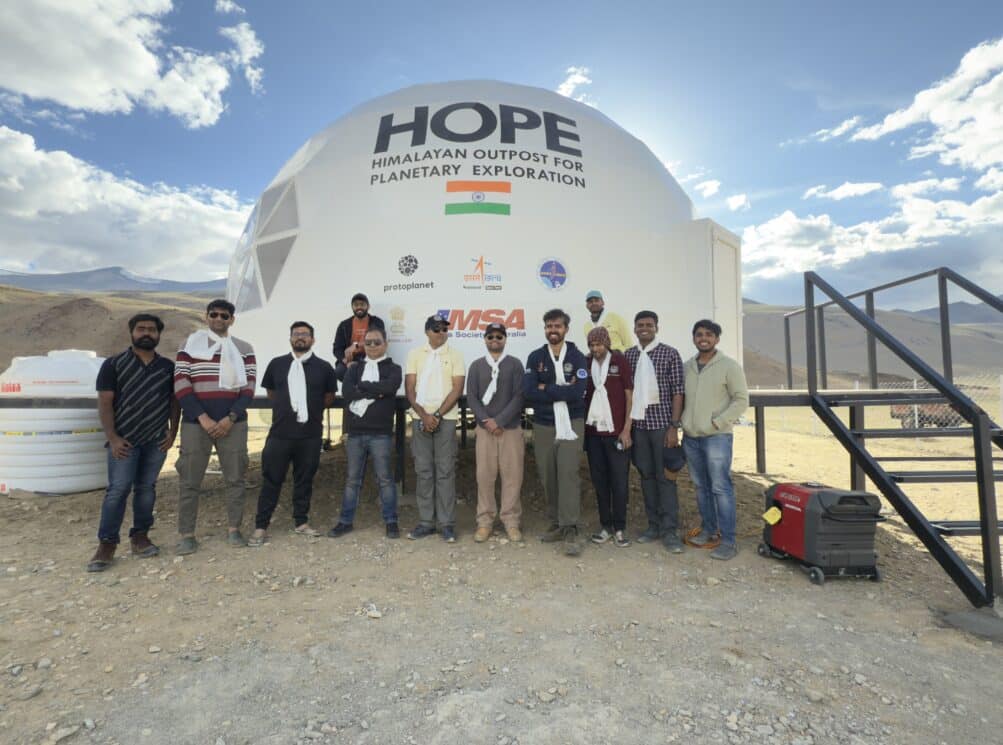
Mars, two billion years ago
Ladakh's high-altitude cold desert recreates conditions thought to resemble early Mars when the planet was warmer and wetter — making it a rare natural laboratory for astrobiology and planetary science.
The region offers an unusual concentration of analogue sites within reach of one another: ancient lake beds, saline permafrost, geothermal hot springs and dust-devil fields. Thin, dry air, intense ultraviolet flux, freezing extremes and low atmospheric pressure all echo the surface environment of Mars and the Moon.
Those same features have made Ladakh a focus for India's wider analogue effort, including instrument trials and microbial-life studies that inform the design of experiments and payloads for future planetary missions. The 2025 expedition concentrated on three areas — Saboo, Tso Kar and Puga — chosen for their scientific value and their resemblance to the Martian surface.
Decades of analogue experience, applied in the field
MSA drew on its long involvement with stations such as the Mars Desert Research Station (MDRS) in Utah and the Flashline Mars Arctic Research Station (FMARS) in the Canadian high Arctic, together with design work for a proposed Australian station at Arkaroola.
Training & operations design
Developing the protocols and methodologies for crew training, scientific research and day-to-day operations within a simulated Mars environment.
Habitat & internal layout
Contributing to the architectural and interior planning of the research station to optimise functionality and habitability for analogue missions.
Systems selection
Advising on the equipment, technology and life-support systems needed to conduct effective research and realistically simulate mission activities.
Leading the expedition
MSA scientists led the technical effort in the field and guided an international team of researchers through the 2025 Spaceward Bound programme.
Who led the team in the field
Mars Society Australia's two senior scientists led the technical effort, working alongside Protoplanet's director as the programme's coordinating lead.
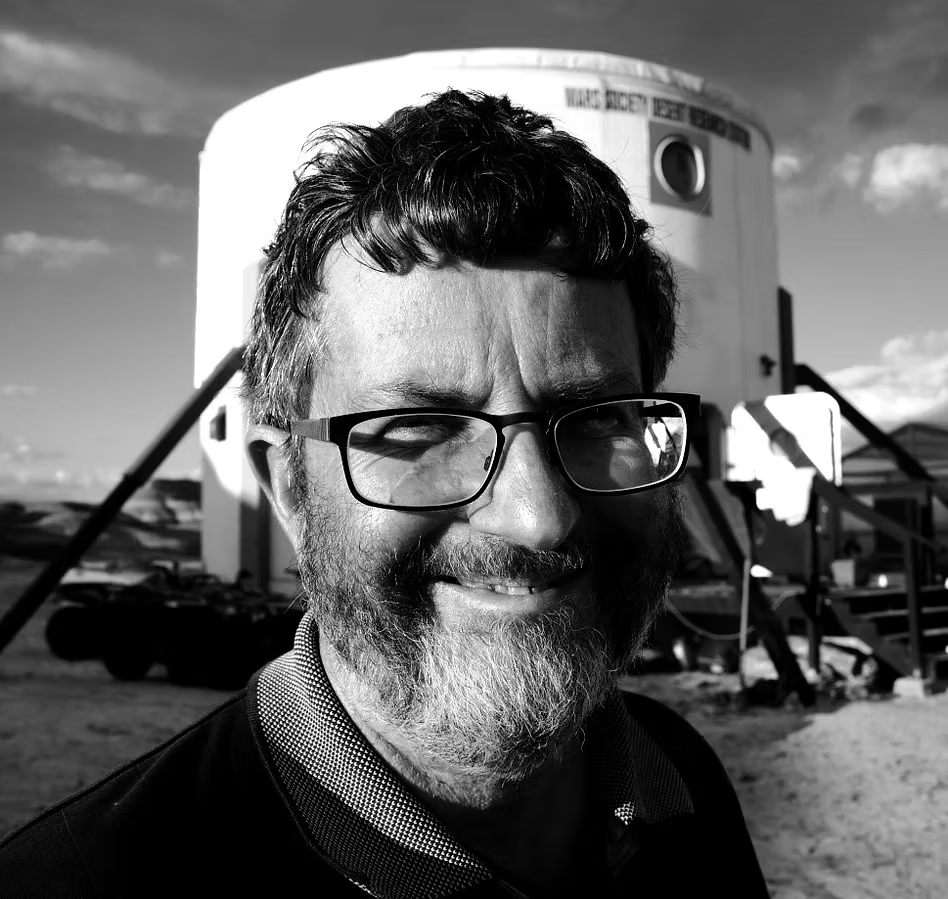
Dr Jonathan Clarke
A geologist with extensive field experience across Utah, the Arctic, Australia and New Zealand, Dr Clarke has trained students and researchers in Ladakh since 2016. He led the technical effort and the international research team for the 2025 expedition.

Dr Annalea Beattie
An artist-researcher who has led and joined numerous Mars analogue expeditions across the US, India and Australia. Her long-term work focuses on the human challenges of living in extreme environments and frontier societies beyond Earth.

Dr Siddharth Pandey
A space engineer with experience at NASA and on analogue expeditions across the US, Australia, New Zealand and India. Since 2016 he has helped build India's terrestrial-analogue and astrobiology community, and coordinated the 2025 programme as Protoplanet's nodal lead.
What the expedition set out to achieve
Protoplanet and the University of Ladakh framed the programme around five linked goals, capped by a one-day technical workshop on "Terrestrial Analogues and Space Missions" at the University of Ladakh.
Characterising the analogue
Establishing Ladakh as a high-value scientific analogue to support upcoming astrobiology, space-biology and planetary-science missions.
Technology testing
Field-testing, maturing and integrating technologies for both robotic and crewed space missions.
Operations testing
Trialling humans-in-the-loop scenarios that mirror how robotic and crewed missions will actually be run.
Infrastructure testing
Supporting explorers in the field while testing habitat and field-based infrastructure under real conditions.
Industry & academia
Building collaboration between industry and research institutions to develop training environments and support researchers.
Local engagement
Bringing Ladakhi youth and students into hands-on fieldwork across geology, biology, remote sensing and engineering.
The expedition route
After arriving via New Delhi and Leh, the team acclimatised at Saboo before moving to the high-altitude analogue sites, returning for the University workshop and outreach.
Arrival & acclimatisation
Flights via New Delhi to Leh, rest at altitude, registrations, equipment and health checks.
Geology briefings
Optional trip to the Indus–Zanskar confluence, plus overviews of Ladakh's geology, climate and recent research.
Core fieldwork
Sample collection and analysis, rover trials, habitat-system tests and night-time astrophotography, with field stops at Upshi and Taglang La.
Workshop & close-out
One-day technical workshop at the University of Ladakh, outreach, creative activities and the concluding ceremony.
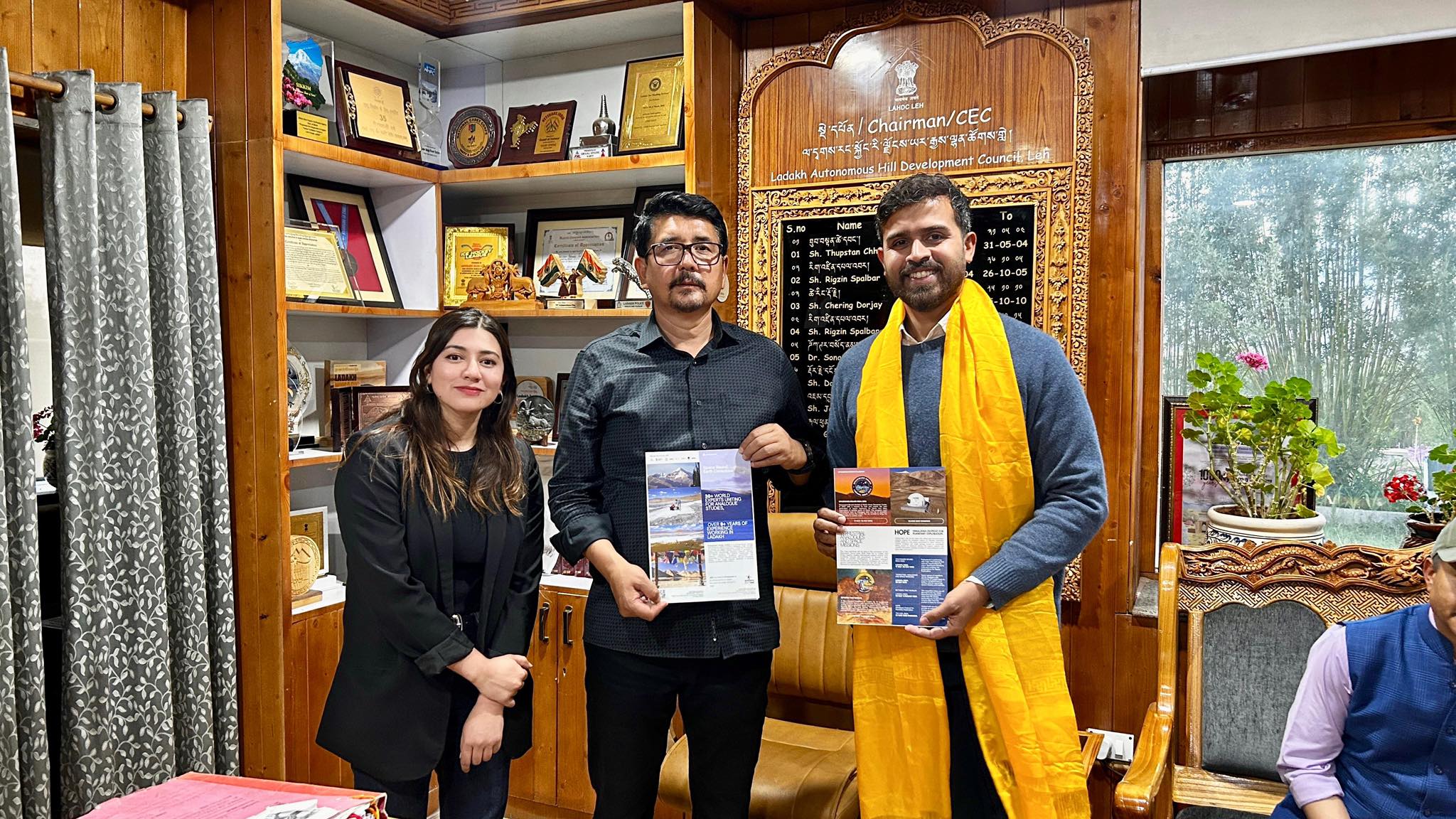
Backed by Ladakh's administration
Ahead of the expedition, Chief Executive Councillor Tashi Gyalson met Protoplanet director Dr Siddharth Pandey to discuss the programme and its potential for the region. The meeting covered medical support, emergency preparedness and educational outreach, with the Hill Council pledging its full backing and stressing safety protocols and community engagement.
Gyalson described the initiative as a milestone in Ladakh's growing role in global science — one that brings research to the region while inspiring local students and opening doors in science, technology and innovation. Organisers expect Spaceward Bound to help establish Ladakh as a lasting hub for extreme-environment research.
From field school to crewed mission
The collaboration laid groundwork for HOPE — the Himalayan Outpost for Planetary Exploration — India's first full-scale crewed Mars analogue mission. In August 2025, two analog astronauts lived and worked in isolation for ten days in the Tso Kar valley, with MSA's Dr Jonathan Clarke and Dr Annalea Beattie taking part. The project is led by Protoplanet with ISRO and the Mars Society.
Voices from the collaboration
Analogue stations are crucial testbeds for the technologies, procedures and human factors that future Mars missions will demand.
Dr Robert ZubrinPresident & Founder, The Mars SocietySeeing leading organisations and experts join this effort is incredibly encouraging for India's analogue research.
Dr Siddharth PandeyDirector, ProtoplanetProjects like Spaceward Bound bring valuable research to the region and inspire our young minds.
Tashi GyalsonChief Executive Councillor, LadakhWho made it happen
Protoplanet — a registered ISRO space tutor — acted as the central coordinating body, bringing together national and international partners and liaising with the ISRO Human Spaceflight Centre.
Learn more
- ProtoplanetProtoplanet — Projects & Spaceward Bound India 2025
- The Mars SocietyMars Society joins Protoplanet to establish a Mars analogue training environment in Ladakh
- The Mars SocietyIndia's first crewed Mars analog (HOPE) launches with Protoplanet, ISRO & the Mars Society
- Indus DispatchLadakh to host Spaceward Bound India 2025 — CEC Tashi Gyalson meets Dr Siddharth Pandey
Support analogue research
Mars Society Australia's fieldwork in Ladakh is part of a wider mission to prepare humanity for the exploration and settlement of Mars. Join us, or follow where we go next.
Become a Member Contact MSA