
Spaceward Bound
New Zealand 2015
New Zealand’s first national expedition to study astrobiology-related extreme environments — a Moon–Mars analogue science and education programme in the Taupo Volcanic Zone.
In January 2015, the New Zealand Astrobiology Initiative (NZAI) organised a 6-day expedition for Kiwi educators and researchers, introducing them to the wonders of the Taupo Volcanic Zone. Partnering with NASA and incorporating speakers from around the globe, Spaceward Bound New Zealand 2015 exposed its 50 participants to astrobiology research through hands-on field trips, and promoted New Zealand as a world-class site for astrobiology research. Mars Society Australia helped seed the expedition and contributed scientists, educators, students and analogue-rover technology to the field campaign.
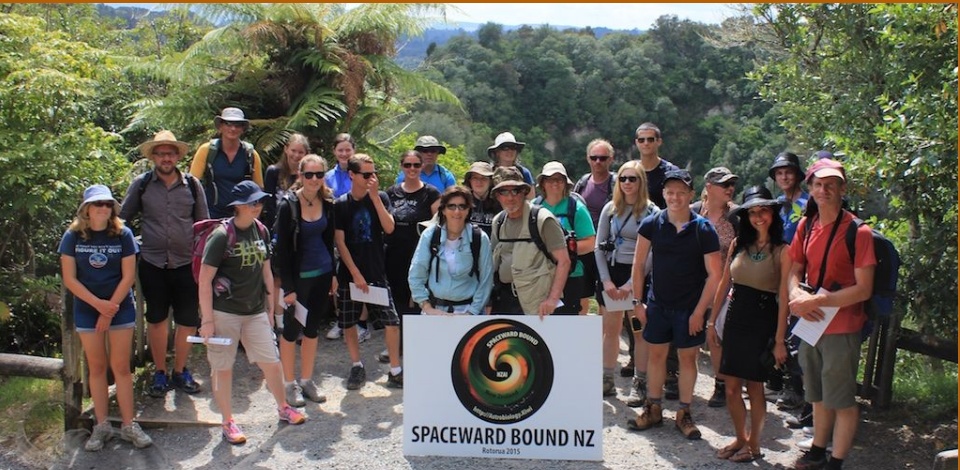
Australia’s role in the expedition
The idea for a Spaceward Bound expedition in New Zealand crystallised through early conversations with Jonathan Clarke and David Willson of Mars Society Australia, building on a long-standing partnership between MSA and the New Zealand space community — including the KiwiMars (2012) and TasMars (2013) analogue missions to the Mars Desert Research Station in Utah.
Jonathan Clarke, MSA President and Research Director, joined as a research scientist and organiser. MSA also contributed analogue-rover capability: the Junior Rover field trials at Parariki Stream were run in collaboration with Steven Hobbs (MSA), and the remote-sensing approach is documented in MSA’s Mars’Obot work (see Reports & Papers below). Educator–artist Annalea Beattie led the Dark Skies drawing project, while Ken Silburn and graduate student Cristiana Paraschiv rounded out the MSA contingent.
What is Spaceward Bound?
Spaceward Bound is an inquiry-based astrobiology and educational Moon–Mars analogue science expedition. It originated at NASA Ames Research Center in 2006, and its primary mission is to train the next generation of space explorers by teaming teachers and scientists to explore scientifically interesting but remote and extreme environments on Earth as analogues for human exploration of the Moon, Mars and other planets.
Previous Spaceward Bound destinations have included the United States, Canada, Namibia, the United Arab Emirates and Australia. The 2015 expedition was the first ever held in New Zealand, organised by NZAI — a group of the Royal Astronomical Society of New Zealand (RASNZ) and the first organisation in New Zealand to recognise astrobiology as its own discipline.
New Zealand as an astrobiology field site
New Zealand features some of the best sites in the world to study astrobiology-related extreme environments. Its dynamic and active geological setting, combined with deep science capability, supports astrobiology research. Within the Taupo Volcanic Zone, New Zealand has unique extremophiles in its hot springs and recent, current explosive volcanism. Other regions offer access to the K–Pg boundary (Marlborough) and the Dry Valleys of Antarctica.
New Zealand is also a world-leader in biosecurity — essential to planetary protection — and has a rich cultural heritage derived from exploration, as Polynesians and Europeans arrived guided by the stars. Local scientists span most of the fields required in astrobiology: microbiology, ecology, biosecurity, physics, astronomy, radio astronomy and geology.
The programme
The home base was Te Takinga Marae at Mourea, Rotorua, hosted by Ngāti Pikiao. The expedition opened with a waka voyage in Auckland harbour with Polynesian navigators — a deliberate link between Māori celestial navigation and the challenges of space exploration — and ran six days of field trips, talks and practical work.
- Thu 15 Jan · AucklandWaka Hourua HaunuiInternational participants sailed with Polynesian Māori navigators from the Maritime Museum of Auckland.
- Day 1 · Fri 16 JanPōwhiri & Kuirau ParkTraditional welcome at Te Takinga Marae; first field trip to Kuirau Park to observe colours and temperatures in hot springs using probes.
- Day 2 · Sat 17 JanWaimangu Volcanic ValleyWalk and observation of geothermal environments, extremophiles and biomarkers.
- Day 3 · Sun 18 JanTongariro & Sulphur PointPlant succession on lava flows in the Mangatepopo Valley and a climb via the Red Crater; meanwhile the rover team supported a public open day at Sulphur Point.
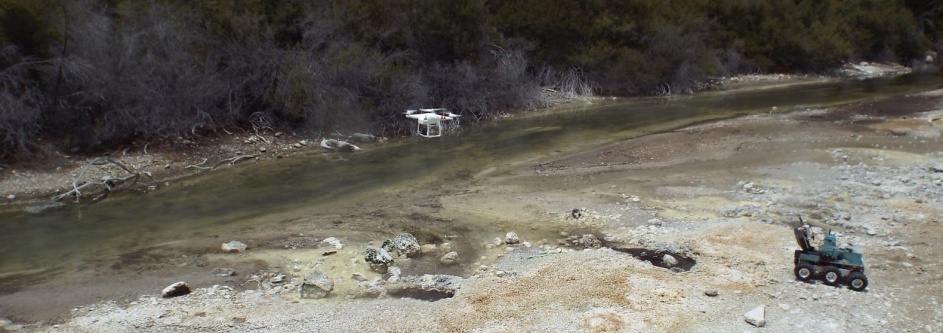
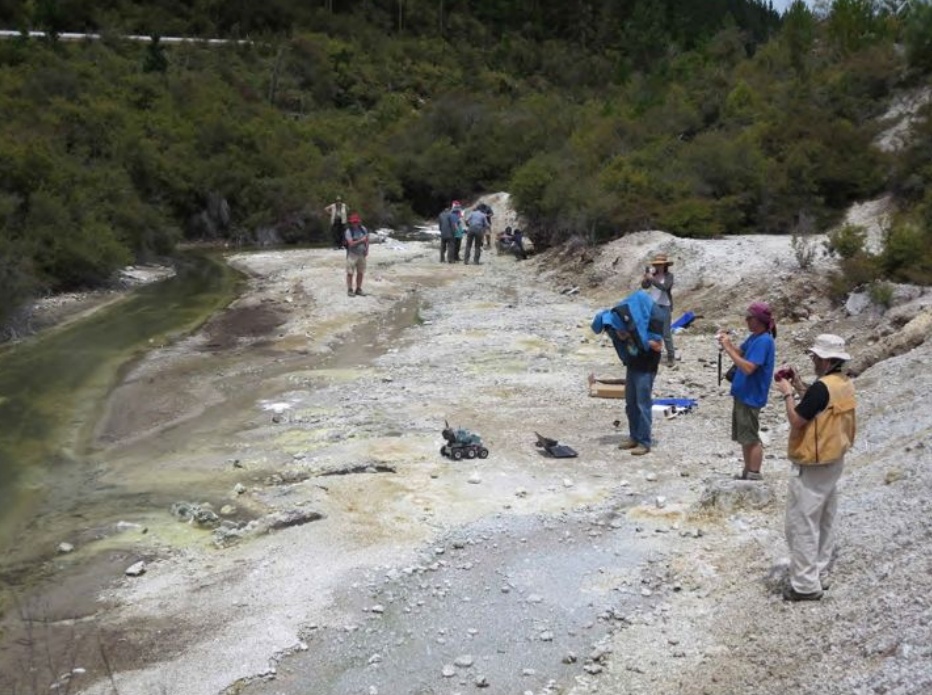
- Day 4 · Mon 19 JanParariki Stream (Rotokawa)Detailed biomarker observations in a silica terrace; rover and DJI quadcopter operated to collect physical data and water samples.
- Day 5 · Tue 20 JanCommunity Open DayParticipant-run workstations, rocketry and microscope activities for children, plus TV and print interviews.
- Day 6 · Wed 21 JanConclusionsEnding presentations and panel discussions on education and networking. (The planned 22 Jan trip to White Island was cancelled due to rough seas.)
Field sites & Mars analogues
Kuirau Park & Waimangu
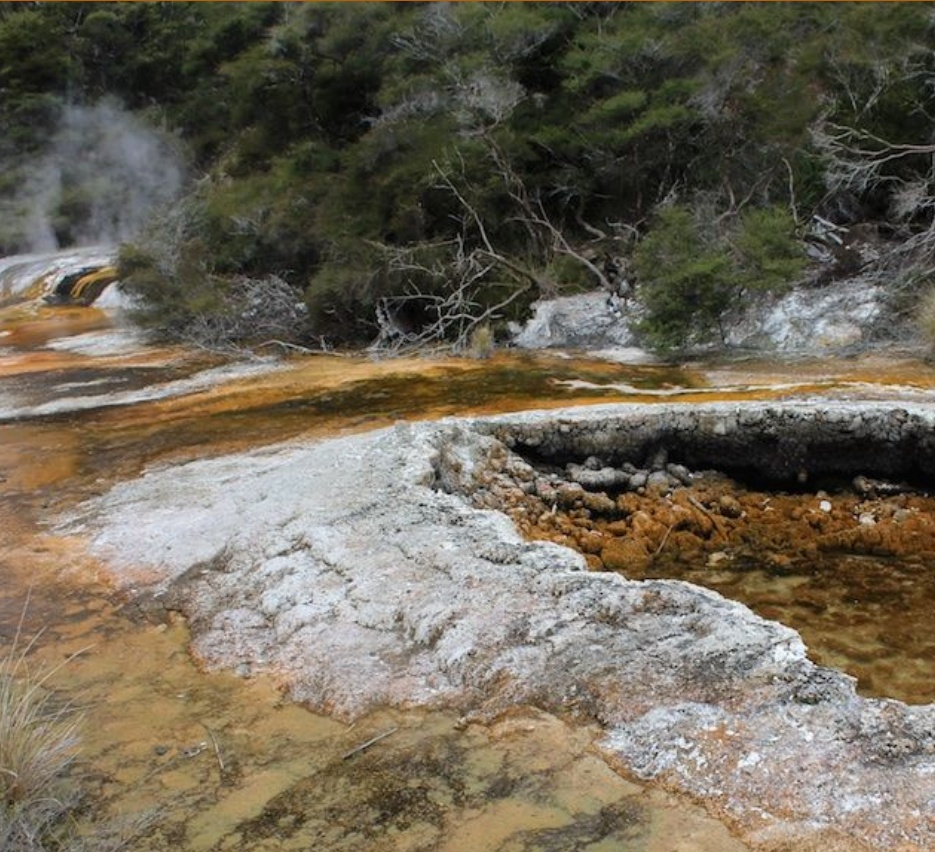
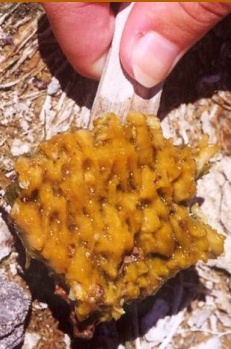
The expedition examined the hydrothermal systems of the Kuirau Park / Waimangu geothermal fields and their extremophile habitats. Instructional staff focused on fossil hydrothermal systems as a possible target in the search for life on Mars, characterising the chemistry and mineralogy of the rocks and the physical and chemical properties of the waters.
Mangatepopo & Tongariro
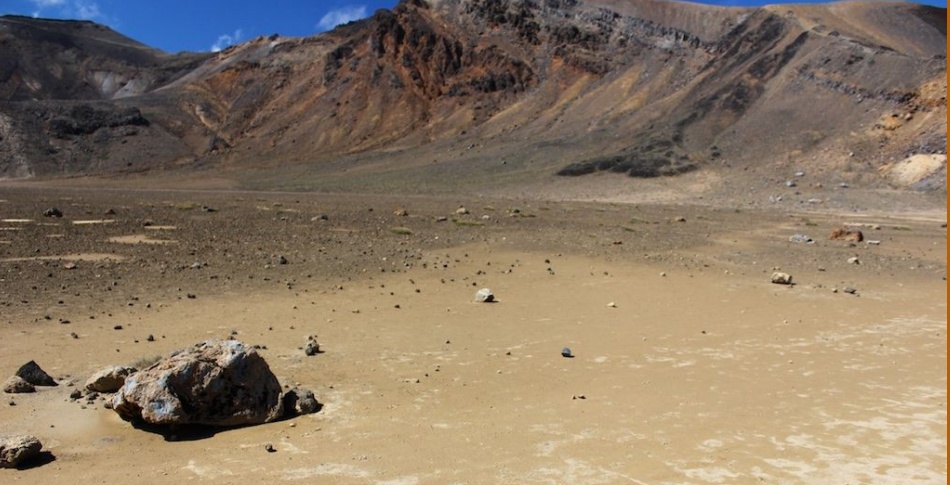
On the Tongariro Plateau — a landscape of basaltic and intermediate-composition eruption products — space exploration was used as a hook to investigate the tenacity of life in hostile environments, led by Julian Thomson (GNS Science) and Katy Hodgson.
Sulphur Point
A public open day at Sulphur Point, Rotorua — run by Professor Steve Pointing — drew about 200 visitors and members of the public, alongside a group from the KiwiSpace Foundation, who saw small science rovers and drones trialled at a present-day geothermal field.
Parariki Stream (Rotokawa)
Parariki Stream is an outstanding Mars analogue: an acid-sulphate-chloride spring in a river bed, uncommon on Earth. The silica hot springs here are similar to the Martian silica at the Home Plate site, and the team investigated which biomarkers are present that might hold clues to similar processes on Mars (investigation led by Professor Kathy Campbell).
Science & research
Samples collected during the expedition were successfully returned to NASA Ames and JPL. Under the guidance of Kathy Campbell (University of Auckland), Dr Rosalba Bonaccorsi (SETI Institute / NASA Ames) — with Dr Carol Stoker and David Willson — sampled the Parariki hot springs and sinter, assaying with the Limulus Amebocyte Lysate (LAL) test to quantify the “Lipid A” biomarker and map the distribution of gram-negative-like biomass.
David Willson and Carol Stoker also collected samples for the reference library of the SOLID immunoassay instrument, designed to search for evidence of life on Mars. At JPL, Dr Parag Vaishampayan’s group is conducting a next-generation sequencing study to inventory the microbial community — his PhD student’s topic, “Microbial community structure of acid-sulphate-chloride springs at Parariki Stream, New Zealand”, applies NGS, ATP and qPCR assays to these low-biomass, low-pH, high-temperature samples.
The Junior Rover
Sampling at Parariki was carried out with the Junior Rover in collaboration with Steven Hobbs (Mars Society Australia), acquiring in situ data and simultaneous spectral measurements alongside drone-based water sampling. These Astrobiology-Technology trials demonstrated how rovers and drones can scout, sense and sample extreme terrains — the same capability MSA explores in its Mars’Obot ground-based remote-sensing programme.
Outcomes
As New Zealand’s inaugural national astrobiology expedition, SBNZ 2015 raised awareness of the field domestically and promoted New Zealand internationally as a premier analogue field site. A high media profile before and during the expedition helped kick-start the New Zealand astrobiology community.
Two posters were accepted at the Astrobiology Science Conference (AbSciCon) 2015: “NASA’s Spaceward Bound New Zealand: The Inaugural Expedition, in the Taupo Volcanic Zone” and “Advancing Astrobiology Curriculum via Teacher–Scientist Collaboration in the Taupo Volcanic Zone”. The expedition seeded the New Zealand Astrobiology Community Portal (astrobiology.kiwi), generated lesson elements for the secondary Earth and Space Sciences (ESS) curriculum, and prompted consideration of a collaborative tertiary-level astrobiology programme.
Putting the “astro” back into astrobiology
Evenings combined the inflatable Cosmodome planetarium, telescope observations and Māori starlore. The Dark Skies drawing project — designed by MSA’s Annalea Beattie — challenged participants to interpret the night sky qualitatively and to consider the role of light pollution, while award-winning astrophotographer Mark Gee (Astrophotographer of the Year 2013) gave a guest lecture.
Australian participants
Of the fifty participants from five countries (New Zealand, Australia, United States, Romania and Kazakhstan), the following came from Australia, several through Mars Society Australia:
| Name | Affiliation | Role |
|---|---|---|
| Jonathan Clarke | Mars Society Australia | Research Scientist / Organiser — MSA President & Research Director |
| Steven Hobbs | UNSW / Mars Society Australia | Research Scientist — Junior Rover (SB alumnus) |
| Annalea Beattie | Mars Society Australia | Educator / Artist — Dark Skies project |
| Ken Silburn | Mars Society Australia | Teacher / Educator (SB alumnus) |
| Cristiana Paraschiv | Mars Society Australia | Student (graduate) |
| Martin J. Van Kranendonk | Australian Centre for Astrobiology | Research Scientist / Professor |
| Chris Kennell | UNSW | Student (graduate) |
| Courtney Bright | UNSW | Student (graduate) |
| Tremayne Kaseman | UNSW | Student (graduate) |
| Siddharth Pandey | Manurewa High School (listed as Australia) | Student (graduate) |
David Willson, closely associated with MSA and credited among its members in the expedition’s conception, is listed in the report under his NASA Ames affiliation.
Reports & papers
- Spaceward Bound New Zealand 2015 — Final Expedition Report (PDF)
- Astrobiology with Mars’Obot: Identifying Microbial Life Forms Using Ground-based Remote Sensing — read the paper (PDF)
Adapted from the NASA Spaceward Bound New Zealand 2015 Final Report (New Zealand Astrobiology Initiative, May 2015; Director: Haritina Mogoșanu). Spaceward Bound originated at NASA Ames Research Center. Mars Society Australia was a partner organisation.