
Mars Analogue Expedition · Flinders Ranges, SA
Arkaroola Mars Rover
Challenge Expedition 2014
A two-week field expedition in the Flinders Ranges of South Australia, where student- and volunteer-built robots, simulated spacesuits and a remote mission-control link were put to the test in one of Earth's most Mars-like landscapes.
01The Expedition
The Arkaroola Mars Robot Challenge Expedition was a joint initiative of Saber Astronautics and Mars Society Australia, run in collaboration with Mars Society India. It was the latest in a series of MSA analogue expeditions reaching back to 2001, following earlier campaigns in the Pilbara, at the Mars Desert Research Station in Utah, and at Arkaroola itself.
Conducted over two weeks in July 2014, the expedition brought together 28 participants — students from Murdoch University, UNSW, Macquarie University and IIT Bombay, university researchers, MSA volunteers, two researchers from Saber Astronautics, and a representative from Fairfax Media. Support crews in Sydney, Canberra and Melbourne backed the team in the field.
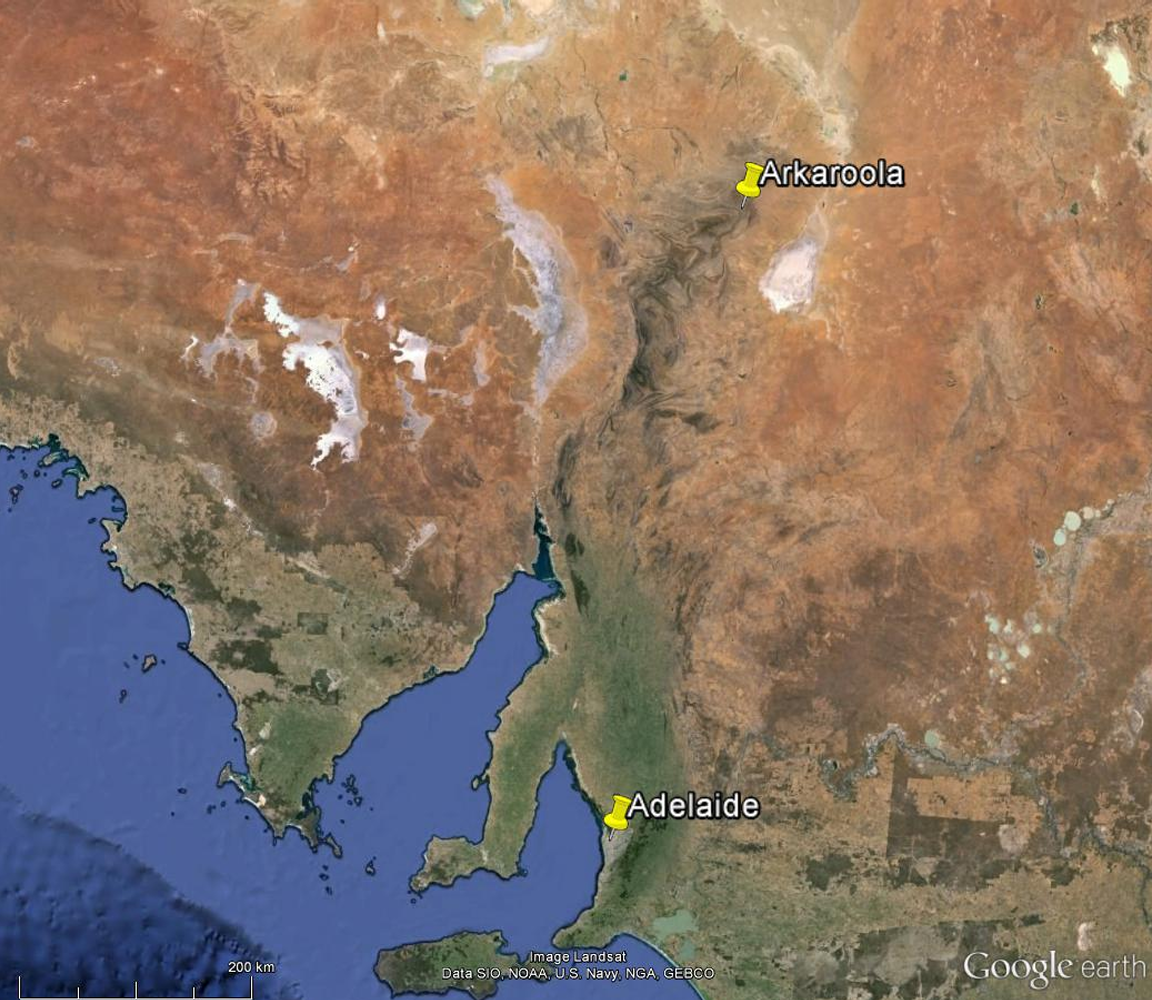
The goal was to carry out research across several fields relevant to Mars exploration in a Mars-like environment, side by side with education and public-engagement programs. Arkaroola was chosen for its rich planetary-science features, its diversity of terrains for engineering tests, its outreach potential, the logistic support of the Arkaroola Wilderness Sanctuary, and a long heritage of analogue and astrobiological research at the site.
02Why Analogue Research?
Analogue research is an invaluable step between the laboratory and an actual mission. Mars and other Solar System analogues place researchers, educators and students in environments that resemble conditions found elsewhere in the Solar System, allowing concepts and hardware to be tested in realistic settings.
The work at Arkaroola spanned programs of investigation — controlled experiments with specific parameters — and programs of opportunity, where engineering and geobiological research is carried out in the analogue region. In practice this meant standardised robot trials, remote-operations experiments, simulated EVAs, spacesuit field studies, and astrobiology fieldwork.
Expedition Aims
Test field-robotic systems under standardised and operational conditions · trial remote control of field operations from Saber's Sydney control centre · conduct simulated extra-vehicular activities (EVAs) · explore field science while wearing simulated spacesuits · investigate geobiological evidence for ancient life · train participants in astrobiology, astrogeology and science communication · and engage the public and inspire STEM teachers. All goals were met.
03The Seven Robots
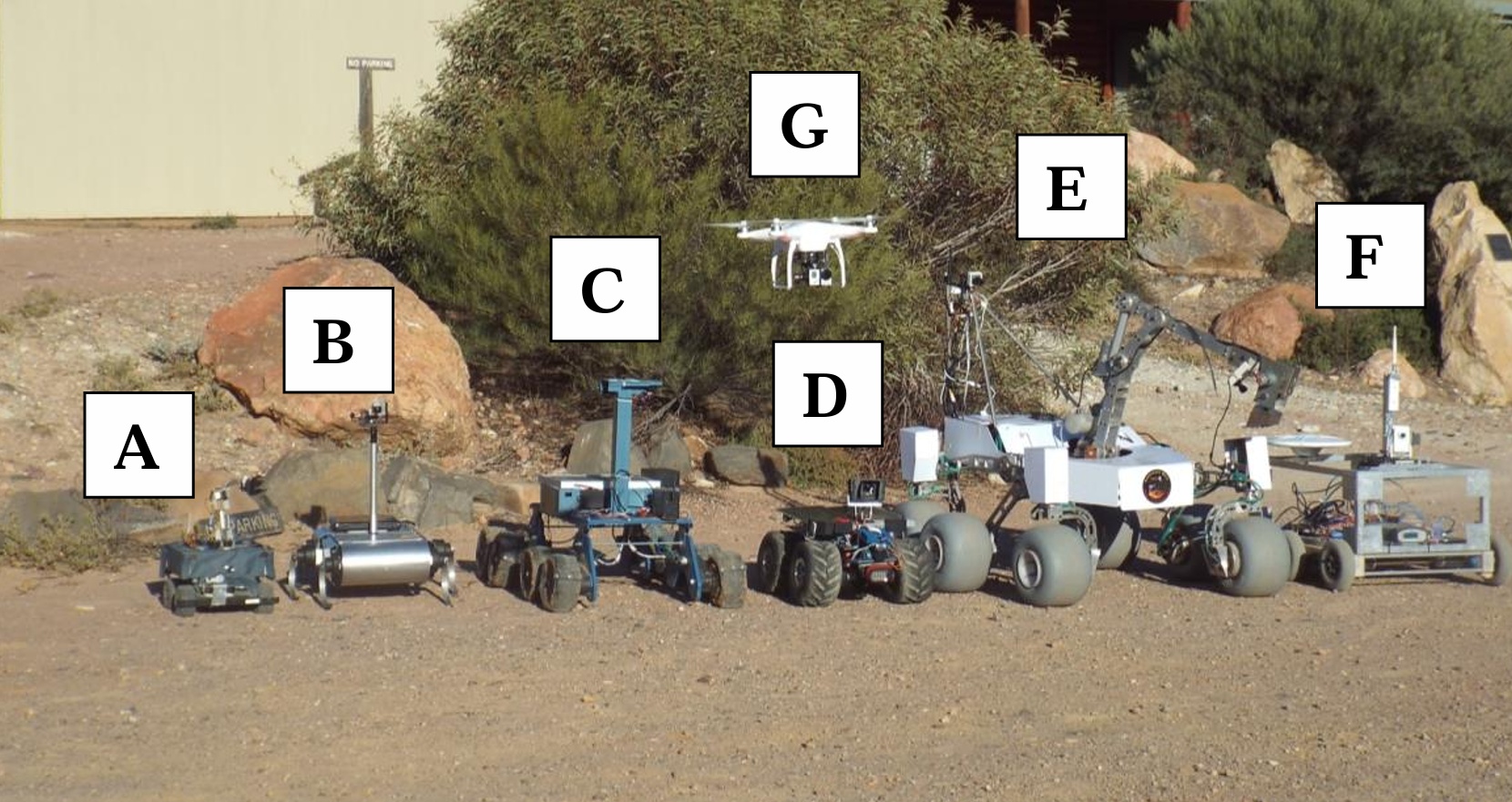
Seven machines took part, built and operated by teams from Mars Society India, Murdoch University, UNSW and Mars Society Australia. These were not autonomous explorers like Curiosity or Yutu; they were conceived as locally controlled robots that support human surface activity — routine maintenance, remote tasks and astronaut EVA support — so issues of interplanetary latency and autonomy were set aside.
| Robot | Operator | Description | Investigations | Key features |
|---|---|---|---|---|
| MSI Rover | MSI | Custom 6×6 bogie rover with skid and four-wheel steering | Remote operations tests | 11.1 V LiPo (56 Ah); three FPV cameras (180° FoV), compass, GPS; 900 MHz serial command link and 2.4 GHz video link; 3-DoF arm with soil-sampling scoop or gripper. |
| Corobot | Murdoch | Modified off-the-shelf 4×4 rover | Rover trials | 2×6 V NiMH; fixed camera, two IR detectors, GPS, force sensors, bump switches; 802.11n Wi-Fi; 5-DoF manipulator with power screwdriver. |
| Mascot | Murdoch | Custom hexapod with sprung revolute legs for tripod walking | Rover trials | 2×18 V motors, 11 Ah LiPo; pan-tilt PAL camera with 1.4 GHz video transmitter, microphone; 900 MHz analogue RC; 5-DoF still-camera mount. |
| UNSW Rover | UNSW | Modified off-the-shelf 6×6 skid-steer rover | Rover trials | 2×18 Ah SLA; pan-tilt and fixed cameras, GPS, pitch-roll inclinometers; 2.4 GHz 802.11n Wi-Fi; custom 4-DoF manipulator, lidar. |
| Miner | MSA | Custom 8×4 rocker-bogie, skid-steer rover | Rover trials & remote operations | 12 V SLA + 12.2 V LiPo; pan-tilt camera with 5.8 GHz video, two sonar detectors; 2.4 GHz analogue RC; 20 W solar panel. |
| Little Blue | MSA | Custom 4×4 skid-steer rover | Rover trials & remote operations | 14.8 V + 12.2 Ah LiPo; pan-tilt camera with 5.8 GHz video, two sonar detectors; 2.4 GHz analogue RC; custom filter-wheel spectrometer, 40 W solar panel, LED lighting. |
| Phantom 2 | MSA | Off-the-shelf quadcopter | Rover trials & remote operations | 5.2 Ah LiPo; pan-tilt camera with 5.8 GHz transmitter to HDMI receiver, GPS; 2.4 GHz analogue RC; helical and omni antennae, on-screen display. |
04Robot Field Trials
Trials were devised by Graham Mann of Murdoch University to allow meaningful comparison between the very different robot designs. Six standardised tasks — based on protocols developed by the US National Institute of Standards (DHS-NIST-ASTM) — were run alongside three operational tasks that approximated the robots' intended real-world purpose.
Standardised Tests
- Logistics & configuration Forms and calibrated photographs captured each machine's physical properties, equipment, configuration and packing — essential for managing configuration from one test to the next.
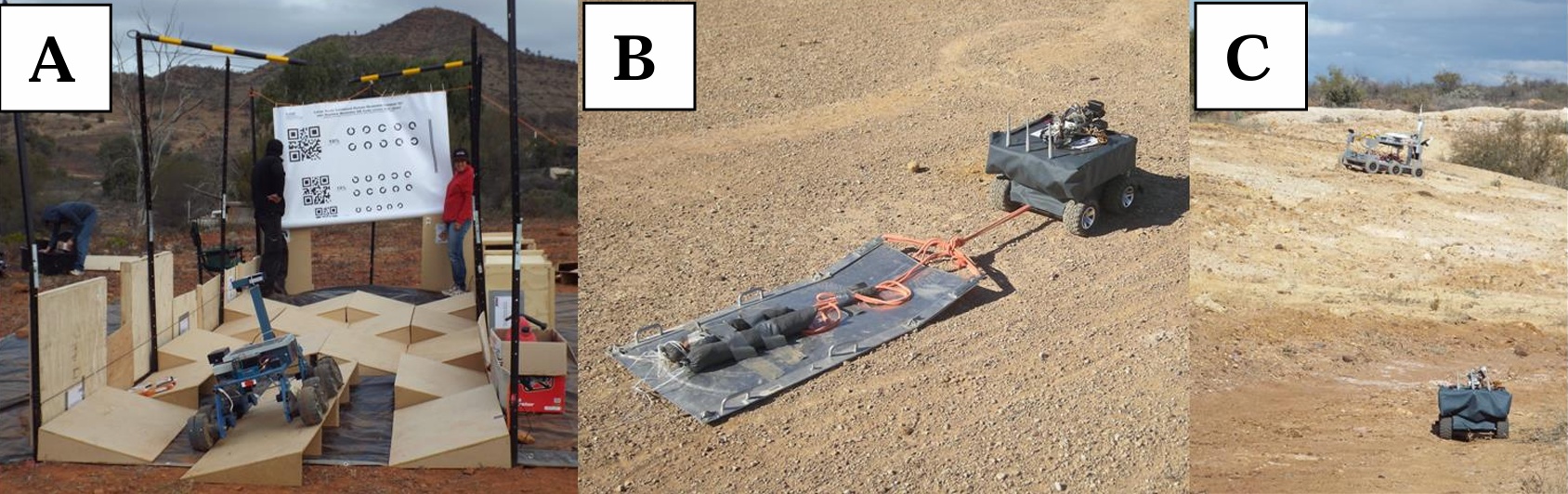
- Endurance on pitch/roll ramps A sawtooth array of 15° ramps measured performance on discontinuous terrain; robots ran a 15 m figure-eight around two pylons until the battery was exhausted.
- Mobility on flat surfaces Ten timed figure-of-eight laps around pylons 50 m apart, staying on the marked path — testing both speed and control. Average speeds were recorded.
- Towing grasped sleds Robots dragged a loaded aluminium sled around the same 100 m course; average velocities and maximum towed weights were recorded.
- Line-of-sight radio comms Navigation and video feed were tested at increasing range, imaging letters and figures on a box atop each station; the last fully reliable station was recorded.
- Video acuity & field of view Operators read Landolt-C charts via the robot camera at far-field and near-field distances, reported as a percentage of the 20:20 standard, with field of view calculated geometrically.
Operational Tests
The three operational tests were run at an abandoned road-metal quarry — slopes of 20° to 40°, loose sand and large irregular rocks:
- Irregular terrain traversal A 106 m course of four gates over rough, Mars-like terrain, video-recorded and timed.
- Context imaging A small painted target was placed 43–76 m away; operators located it by GPS and photographed it in context. Best images were anonymised and rated by three expert field geologists across five criteria.
- Sample return Robots with a manipulator placed a scale beside the target, photographed it, collected it and returned it to the start; time to return was recorded.
05Remote Operations
Saber Astronautics tested its Responsive Space Operations Centre (RSOC), which diagnoses faults by modelling space systems and their environment together in a single global probabilistic model — letting operators respond rapidly without the heavy retraining that conventional methods demand. The same principles apply to surface operations, mission analysis and the optimisation of human-robotic teams.
A communications link connected Arkaroola to the RSOC at Saber's laboratory in Chippendale, NSW, carrying rover telemetry, GPS tracking and mission-support functions such as weather monitoring and remote scientist support. Crucially, all communications were subject to a 20-minute delay representing the latency of real Mars operations, and live space-weather data was folded into the operational model.
| Experiments | Assets | Mission type |
|---|---|---|
| Two | 2 astronauts, Little Blue, Phantom 2 | Geological sortie |
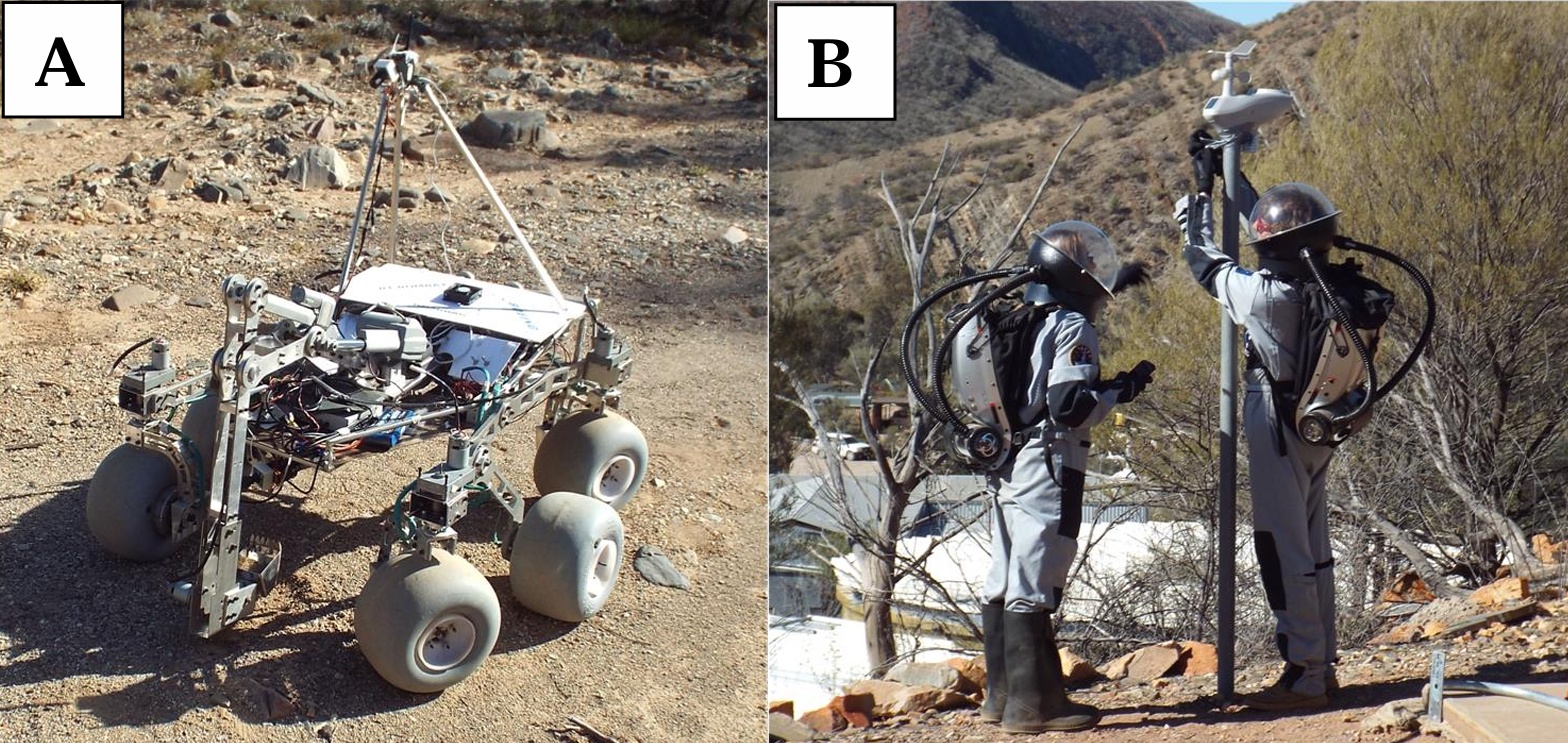
| Two | 2 astronauts | Maintenance (weather station; rover) |
| One | 2 astronauts, Phantom 2 | Geological sortie |
| Six | 2 astronauts, Phantom 2 | Exploration |
| Five | MSI Rover | Exploration |
Missions ran across terrains from smooth dust to rocky creek beds, typically about 60 minutes each, in robot-only, astronaut-only and mixed human-robot configurations. EVA crews wore simulated spacesuits loaned from the Victorian Space Science Education Centre (VSSEC) but originally built by MSA to its own design. Data collected included biometric, GPS and motion telemetry, UHF voice communications, and on-site weather.
06Spacesuit Trials
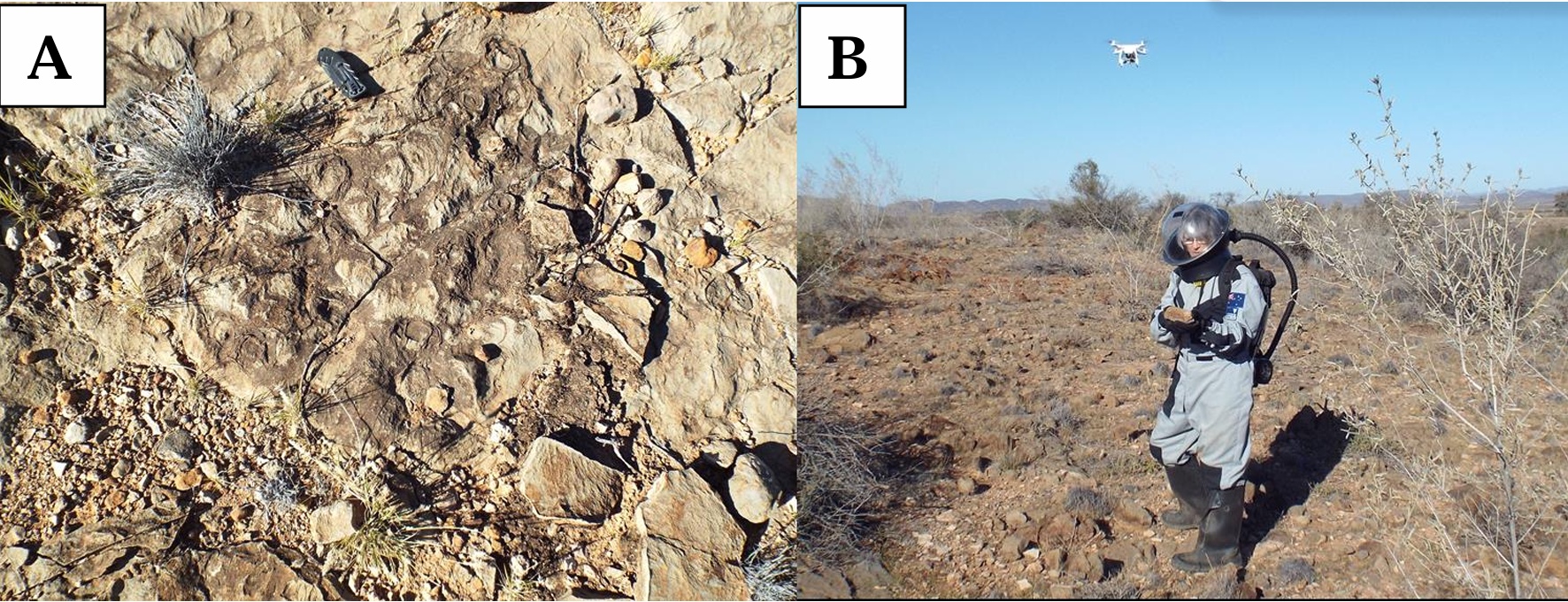
Understanding how a spacesuit constrains fieldwork is critical to planning crewed exploration. Following a methodology first used on an earlier MSA Pilbara expedition (which employed the University of North Dakota's NDX-1 suit), volunteers wore a VSSEC simulated suit. Although unpressurised, the suit impaired sensory awareness and mobility in ways analogous to a real suit.
Geologists and non-geologists were asked to walk a limestone outcrop and identify possible and probable stromatolites within a 20-minute window, with results intended for presentation at the 2015 Australian Space Research Conference.
07Geobiology
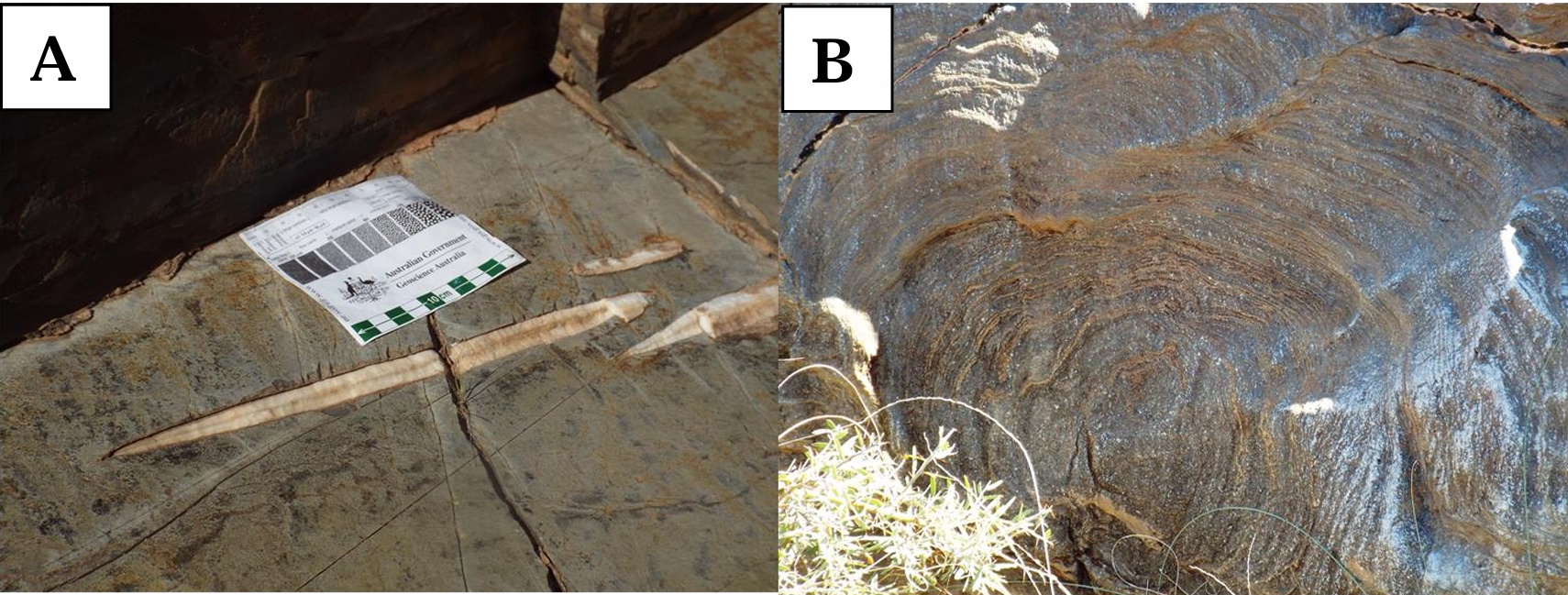
Geobiological research — led by Simon George and Sarah Houlahan — tested hypotheses about ancient biospheres recorded in Cryogenian rocks (850–635 million years old) around Arkaroola. The first concerned the biogenicity of possible microfossil structures in veins of the Tapley Hill Formation, proposed as evidence of a deep hot biosphere. The second asked whether carbonates of the Balcanoona Formation and contemporaneous Tapley Hill siltstones contain biomarkers indicative of fossil sponges.
Beyond their terrestrial significance for understanding the antiquity of the deep biosphere and of complex animals, these questions matter for astrobiology: the putative microfossils resemble structures seen in martian meteorites such as ALH84001, so testing their biogenicity sharpens the tools used to interpret possible martian biosignatures. Biomarkers, likewise, are among the best tools for the search for past or present life on Mars.
08Training & Outreach
Teacher experience
Three school teachers joined the expedition, contributing equipment, taking part in experiments, giving talks and gathering classroom material. Their participation counted toward the Australian Professional Standards for Teachers — Standard 2 ("Know the Content and How to Teach It") and Standard 6 ("Engage in Professional Learning") — letting them anchor geology and space content in a rich, authentic context.
Workshops & field trips
Because most expeditioners were new to Arkaroola and to geology, the first full day was a geological tour introducing field geology, the area's geobiological highlights, and the challenges facing planetary-rover designers. Science journalist Peter Spinks of Fairfax Media ran a two-day media-training workshop — a condition of the Australia-India Council grant — that proved invaluable for later press releases.
Public engagement
Public outreach ran throughout. Evening lectures at Arkaroola — on space camps, life on Mars and the history of life on Earth, planetary robotics and human missions to Mars — drew audiences of 20 to 60. Visiting Melbourne University field-camp students and a group from Mitcham Girls' High School in Adelaide watched the robots at work and discussed science and engineering opportunities for women.
Coverage was extensive: a report in the Times of India, stories from ABC Regional South Australia, and online articles and webcasts by Peter Spinks on The Age's "Science Matters" blog. The robots and suited figures also drew steady curiosity from other visitors to Arkaroola.
09Outcome
The Arkaroola Mars Robot Challenge was a highly successful expedition, with every pre-expedition goal met. It demonstrated the value of multi-goal expeditions for both research and training in an analogue setting. Preliminary results have been published, with more to follow, and Mars Society Australia plans further events — potentially including a field-robotics student competition along the lines of the US Mars Society's University Rover Challenge in Utah.
Credits & Acknowledgments
Authors: Jonathan D. A. Clarke, Jason M. Held, Astrid Dahl, Nicolette Wheaton and the Arkaroola Mars Robot Challenge Expeditioners.
The expedition was partially funded by CSIRO, the Australia-India Council and Saber Astronautics. In-kind support was provided by the Arkaroola Wilderness Sanctuary, Graham Mann of Murdoch University, and the Victorian Space Science Education Centre. The authors thank all expeditioners for the enthusiasm and hard work that made the expedition possible.
Adapted for the web from "Field Robotics, Astrobiology and Mars Analogue Research on the Arkaroola Mars Robot Challenge Expedition," Proceedings of the 14th Australian Space Research Conference, 2014. Full reference list available in the source paper.
Read the original paper