
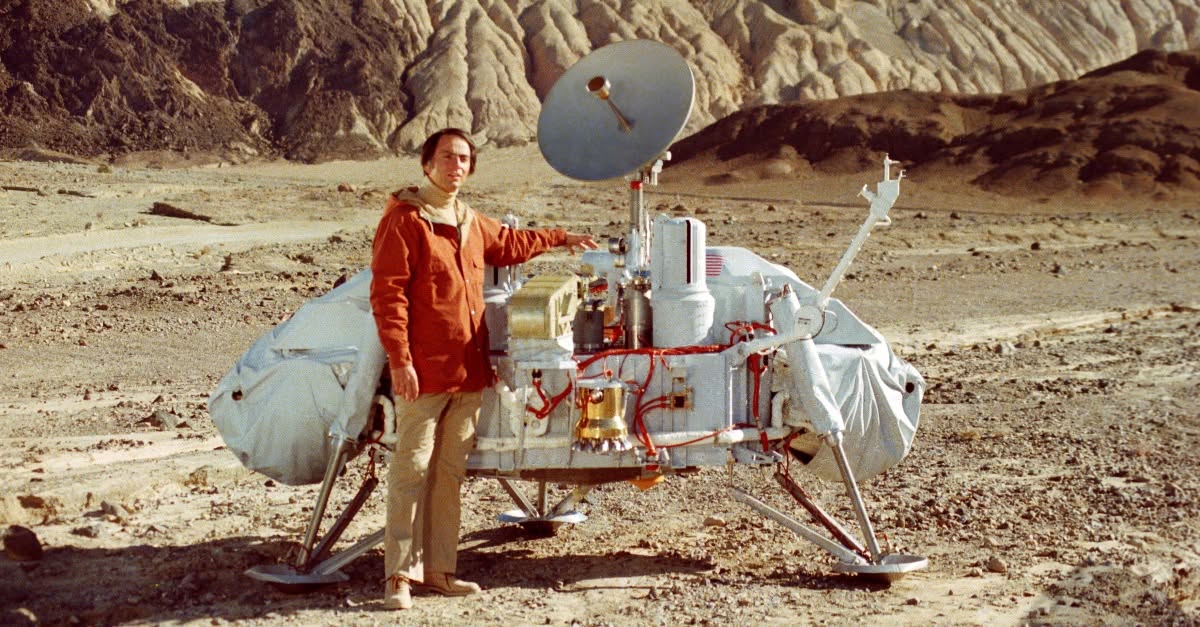
While the 20th of July (or the 21st of July Australian time) will always be remembered as the day that humans first set foot on the Moon during the 1969 Apollo 11 mission, today is also the 50th Anniversary of the touchdown of the first of the two Viking landers on the surface of Mars.
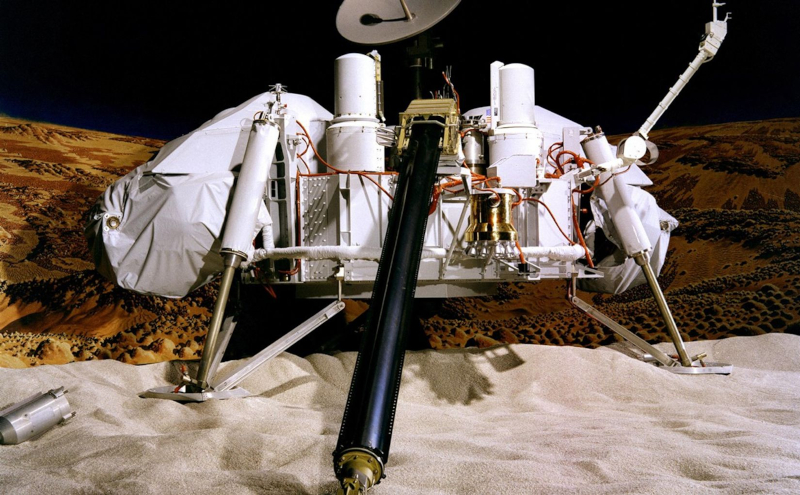
A model of Viking 1 on the surface of Mars. Image via NASA
This mission lasted a number of years and gave us new perspectives on the Red Planet. It provided the first images direct from the Martian surface and collected and analysed soil samples. These were the first laboratory analyses ever performed on another planet.
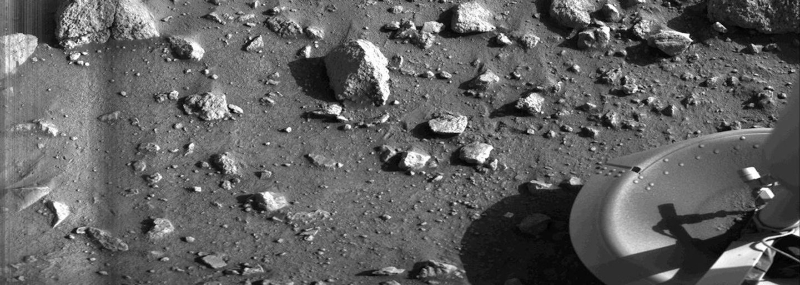
This is the first photograph ever taken on the surface of the planet Mars. It was obtained by Viking 1 just minutes after the spacecraft landed successfully on July 20, 1976. Image via NASA
Search for life.
One of the primary objectives for the Viking landers was to search for signs of past life on Mars. The results were somewhat puzzling and while of offical NASA positon were that no signs of life was found, the results still are debated.
Mars from Orbit.
While the two Viking landers worked away on the surface, their orbiters imaged most of the Martian surface, sending back more than 52,000 images to Earth. They identified volcanoes, canyons, impact craters and ancient river valleys, paving the way for future Mars missions.
A model of Viking 1 with the orbiter of the top and the lander tucked in the aeroshell below. Image via NASA
Long term hardware.
Viking 1 was designed to last 90 days, but continued to operate until 1982. Its orbiter operated under 1980.
A lasting legacy.
The Viking program showed:
- Mars has a cold, dry, carbon dioxide-rich atmosphere.
- Its surface is covered by iron-rich volcanic soil.
- There is strong evidence that liquid water once flowed across the planet, including ancient river channels and catastrophic flood plains.
Resources.
The Viking missions produced a vast trove of scientific data which helped us learn about the Martian past and the conditions on the red planet today.
You can read more at the NASA Viking 1 mission website here.