
Research › Spacesuits
MarsSkin
A decade-long Mars Society Australia program to design, build and field-test analogue mechanical counter pressure spacesuits — garments that squeeze the body the way a real Martian suit one day might, rather than inflating around it.
Project lead · James Waldie
The technology
What is a mechanical counter pressure suit?
Every spacesuit flown to date works by surrounding the astronaut with pressurised gas — effectively a person-shaped balloon that resists every bend of a knee or curl of a finger. A mechanical counter pressure (MCP) suit takes the opposite approach: a skin-tight elastic garment presses directly on the body, holding it at pressure without any gas layer at all.
Paul Webb and James Annis first published the concept in 1967 and, in 1971, demonstrated its advantages in practice. Replacing stiff joints and bearings with light, flexible elastics gave dramatic gains in reach, dexterity and tactility. The approach is also inherently safer — a tear stays a local defect rather than becoming a catastrophic decompression — while cutting suit cost, weight and bulk. MIT flexibility tests in the mid-1980s found MCP gloves measurably better than their gas-pressurised equivalents.
Advances in textiles, yarns and automated knitting have since revived serious interest in MCP, with physiological and design work continuing at groups such as Honeywell, the University of California San Diego, and Clemson University. MarsSkin was MSA's contribution: not a flight suit, but a faithful analogue — one that recreates the fit, restriction and feel of a real MCP suit closely enough to use in Mars analogue research here on Earth.
The build history
Four generations of MarsSkin
Each version of the suit answered the lessons of the last — from a static display piece to a fully instrumented suit deployed in the field on two continents.
-
01
2002 · University of Sydney
MarsSkin 1 — the first prototype
Unveiled at AMEC 2002 on 13 July, the first suit set out to recreate the form-fitting layers, movement restriction and overall look of a real MCP suit. It used a three-layer build — a cotton comfort layer, a snug analogue power layer standing in for the counter-pressure garment, and an outer dust cover — and carried a helmet system developed by first-year engineering students at the University of Sydney. It marked a clear step on from the analogue suits the US Mars Society used at its Devon Island and Utah stations.
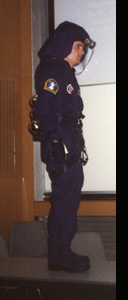 marsskin_fullside.JPG
Prototype on displayThe prototype on display at AMEC 2002. -
02
Expedition One
MarsSkin 2 — instrumented in the field
On its first field deployment the suit gained a datalogger built into the back plate and chest panel, with GPS and power packed into the chest box and a front panel of switches and status readouts. Three things set MarsSkin 2 apart from the existing MDRS suits: head-worn “motorbike” helmets that moved with the wearer for near-unrestricted vision, far more flexible and usable gloves, and the smaller, lighter backpacks that MCP makes possible.
 MarsSkinAnim.gif
Suit, rotating viewsMarsSkin 2 with its instrumented chest panel.  RockyDebriefing.jpg
Expedition One crew in the fieldCrew debriefing during Expedition One, the suit's first deployment. -
03
Expedition Two, Arkaroola · then MDRS, Utah
MarsSkin 3 — the science suit
The most studied version. A new bubble helmet added ventilation, a drink bite-valve and a VOX radio earpiece; rigid-shelled Boblbee backpacks brought the pack volume down close to that of a real MCP suit. The headline change was the Skins layer — a poly-lycra Coolmax garment, with sublimation printing, that simulates the compression of a true MCP suit while wicking heat and perspiration.
Add image
MarsSkin 3 at Arkaroola / the Skins layerFrom the project archive — upload from the Media Library or Flickr set. At Arkaroola the team ran three studies: an analogue glove comparison, a helmet field-of-view test, and full field trials of the suit. The glove study — 30 subjects, with the International Space University and UTS — found MCP gloves added just 65% to task time versus a bare hand, against 232–500% for gas-pressurised gloves. Later, on the MDRS Leonardo and Mona Lisa crews in Utah, crew wore MarsSkin alongside the standard gas-pressurised suits and consistently reported greater comfort, reach and dexterity with less fatigue, especially in the heat.
-
04
Victorian Space Science Education Centre
MarsSkin 4 — built to last
The final generation focused on ruggedness: new hard torso and helmet mounting structures designed for daily use by secondary-school students at the science centre in Melbourne, and durable enough for future MARS-Oz analogue-station deployments. The emphasis shifted from prototype to a reliable system that could be donned, doffed and worn day after day.
Add image
Hard torso / helmet mountFrom the project archive — upload from the Media Library.
From analogue to orbit
The lead: James Waldie
MarsSkin began as the work of a young Australian engineer, and it became the launch point for one of the most persistent careers in spacesuit research. While leading MarsSkin, James Waldie was completing a PhD at RMIT University and running MCP glove physiology studies with Alan Hargens’ lab at the University of California San Diego — the same line of work that produced his early peer-reviewed papers on counter-pressure gloves.
That thread led to the MIT Man-Vehicle Laboratory, where Waldie and Dava Newman developed the Gravity Loading Countermeasure Skinsuit (GLCS) — a skin-tight garment that loads the body from shoulder to foot to mimic standing in Earth gravity, countering the bone and muscle loss of long-duration spaceflight. With the European Space Agency, MIT, King’s College London and others, the concept matured into ESA’s flight SkinSuit, famously inspired by the compression bodysuit Cathy Freeman wore at the 2000 Sydney Olympics and tailored by Italian firm Dainese.
In September 2015, ESA astronaut Andreas Mogensen pulled on the SkinSuit aboard the International Space Station — the first time the idea Waldie had chased for over fifteen years flew in orbit. ESA astronauts trialled it on the ISS in both 2015 and 2017. Today Waldie is Director and Chief Engineer of Human Aerospace, where — with Australian Space Agency support and partners including NASA, ESA, MIT, RMIT University and Cape Bionics — he is developing a family of compression suits for spaceflight, and for use back on Earth.
What Human Aerospace is building now
IVA · Bone
Gravity Loading Countermeasure Skinsuit
Loads the body from shoulder to foot to mimic standing in Earth gravity, helping to maintain bone mass. Tested on the ISS twice.
IVA · Circulation
Orthostatic Intolerance Garment
Strong lower-body compression keeps blood flowing to the brain, reducing the fainting that can strike astronauts on the return to gravity.
IVA · Balance
Sensorimotor Suit
Stimulates proprioception and adds movement resistance, helping to preserve normal balance and coordination in microgravity.
The same compression design has potential on the ground, too — in treating burns, lymphoedema, osteoporosis and cerebral palsy, and in athlete recovery. Australian Space Agency grants now back both the international skinsuit research and custom manufacture, tailored to each wearer through 3D body scanning.
A student-built analogue suit shown in a Sydney lecture theatre in 2002 traces, almost unbroken, to a garment worn by an astronaut circling the Earth. That is the MarsSkin legacy.
Founding references
- Webb, P. & Annis, J. — The Principle of the Space Activity Suit, NASA CR-973, 1967.
- Webb, P. & Annis, J. — Development of a Space Activity Suit, NASA CR-1892, 1971.
Selected MarsSkin-era work
- Waldie, J. et al. — Compression under a mechanical counter pressure space suit glove, J. Gravit. Physiol., 2002.
- Waldie, J. & Newman, D. — A gravity loading countermeasure skinsuit, Acta Astronautica, 2011.
MarsSkin was a project of Mars Society Australia. Image slots are wired to the original project filenames; upload each to the Media Library and swap in its URL to finalise. Placeholder slots marked “Add image” await archive or Flickr photographs.