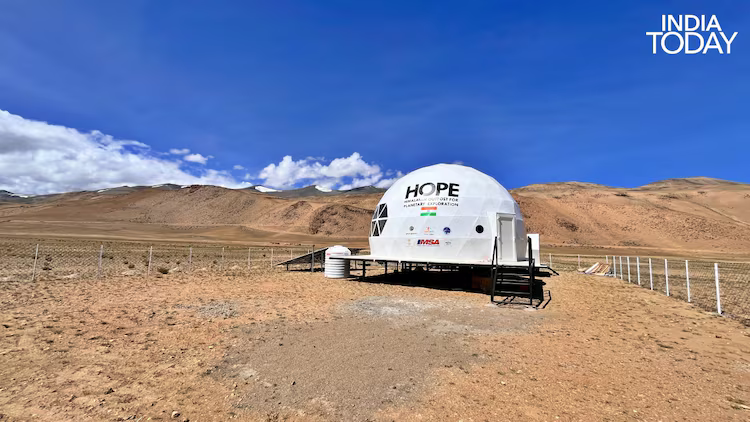
ISRO to help upgrade the HOPE Mars Analogue Station
It was announced today that India's National Space Agency, ISRO, is assisting with upgrades to the HOPE analogue station established by Protoplant and the MSA.These ugrades follow on from a…

It was announced today that India's National Space Agency, ISRO, is assisting with upgrades to the HOPE analogue station established by Protoplant and the MSA.These ugrades follow on from a…

The Mars Society Australia is now calling for nominations for its Board of Directors in its partial annual election as required by our Articles of Association.Nominees need to be Australian…

A new Red Planet Live podcast episode just aired featuring an in-depth look at HOPE in Ladakh, India — the newest addition to the global Mars analog community and an…
Six crew-members will be heading deep into the Utah desert in April/May 2012, to undertake a 2-week mission of exploration and research at the Mars Desert Research Station. Follow them as they…
The Rover chassis was moved from the manager’s carport in Fremantle, WA, where it had been undergoing inspection and rebuilding. During its time there, the concept and design work on the pressurised body shell was substantially reworked. An important development was a wooden mockup which helped verify design ideas and dimensions with respect to ergonomic fitting of the human driver to the controls, a complex but vital design issue for any vehicle. Once this was built and tested, measurements from the mockup were transferred into the AutoCAD design package we’re using for the plans.
More detailed design work has been done towards vehicle certifications and manufacturing plans. Most of this work is done by project Engineer, Bruce Armstrong. We hope that by having everything planned in detailed from the start, we will save money by cutting down on labour costs due to uncertainty and mistakes. But a lot of precious time is taken up by the need for all this documentation; we must find ways to spend less time describing things and more time actually building them.
With clearance from the licensing authorities, work on chassis modification is now under way. Detailed design work in the AutoCad model is now being turned into detailed manufacturing drawings, and these are being distributed to a growing cadre of volunteer mechanics, engineers and materials specialists for realisation into metal and plastic. To better visualize the body shape, a 1/12 scale physical model was built (see photo). Meanwhile, there is plenty of work to do to get the refurbished 3L engine mounted into a steel carry frame and moved over to the Byfield’s factory.
Work continues on the chassis modification, which is being strengthened as well as elongated. Before the 3L engine and gearbox is mounted to the chassis, the opportunity to recondition it is being taken (though the engine is in working order). This involves a good deal of hunting for spare parts – some from generic suppliers and some from Toyota dealers. The donor vehicle continues to be stripped of anything useful, including engine mounts, a vacuum reservoir, and electrical parts. The steel carry frame for moving the engine is now finished.
Much work on the powerplant – a modified 3 litre, diesel engine with 4 x 4 transmission – took place slowly over the past few months. Many components, especially seals, gaskets, clamps and water pipes etc. of the engine were cleaned, inspected, painted and/or replaced. The oil pan was removed, cleaned and painted. A modified oil dump line was fitted and the speedometer cable was removed. The handbrake was dismantled, inspected for wear, tested and replaced. The speedometer cable was removed – it will be replaced with an electronic version.
It’s taken a long time to get further with the project, since both of the main workers have been tied up with other duties (read: paid work). However, at last the steelwork plans were completed and the floor frame and vertical bulkheads are being assembled. Now that this work is in hand, the task for we MSA volunteers is to get busy with the support equipment for the powerplant: exhaust system, coolant plumbing, electrical and transmission.